
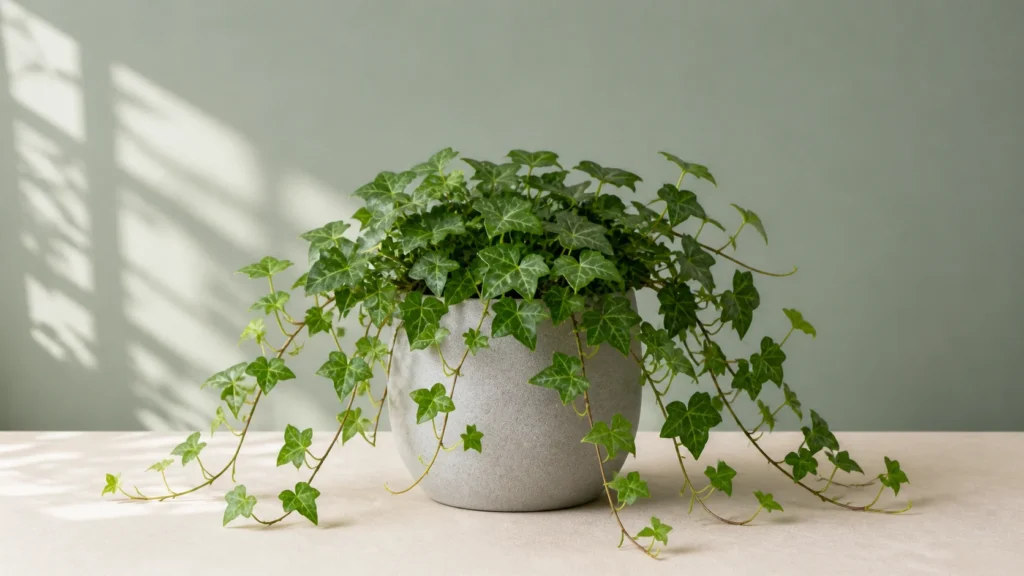
English Ivy
Hedera helix
A fast-growing trailing vine with classic lobed leaves that thrives in cool rooms and bright indirect light — just keep the air moist and the spider mites away.
Watering frequency
Every 7-10 days
Ideal temperature
50-70°F / 10-21°C
Humidity
40-60%
Care difficulty
Easy
Air purifying
Yes
Growth rate
Fast
Plant size
Trails 4-8 ft / 1.2-2.4 m indoors
Soil type
Well-draining all-purpose potting mix with perlite
Fertilizer need
Monthly, spring-summer.
Care summary
- Light: Bright indirect light is best; medium light is tolerated.
- Water: Keep the soil lightly moist, never soggy; allow the top inch to dry.
- Temperature: Prefers cool rooms — it is one of the few houseplants that likes 50-70°F.
- Humidity: Average indoor air is fine, but a boost helps prevent spider mites.
- Safety: Not pet-safe; keep out of reach of cats, dogs, and children.
Common problems
- Yellow leaves: overwatering or soil that stays wet too long.
- Brown, crispy leaf edges: dry air or underwatering.
- Leggy stems with bare gaps: not enough light.
- Sudden leaf drop: temperature swings or cold drafts.
- Spider mites: fine webbing and stippled leaves in dry air.
- Scale or mealybugs: sticky residue on stems and leaf undersides.
Plant care guide
About English Ivy
English Ivy (Hedera helix) is a woody, evergreen climbing vine native to Europe and western Asia, where it scrambles up trees, walls, and fences across a surprisingly wide range of climates. The NC State Extension profile describes it as an evergreen perennial vine in the ginseng family (Araliaceae) that climbs by means of small aerial roots along its stems. The classic juvenile form — the one sold as a houseplant — has leathery, three- to five-lobed dark green leaves with pale veins.
There are two things to know before you buy one. First, the plant you bring home is usually a young juvenile vine; mature ivy grows unlobed, oval leaves and flowers only after years of climbing. Second, this is a plant with a split personality: loved as a forgiving indoor vine, but considered invasive in parts of North America where it escapes cultivation and smothers native ground cover. Indoors, none of that matters — it simply behaves as a tidy, fast-growing trailing plant.
A word on names and varieties. The species name helix comes from the Greek for "spiral" or "twist," a reference to the way the vine twines as it climbs. Ivy has been cultivated for thousands of years — Roman gardens used it as evergreen cover — and breeders have since selected dozens of named varieties. Indoors you are most likely to meet the plain green form, the silvery-edged 'Glacier', or the golden-margined 'Goldchild'; 'Hahn's Self-Branching' is a compact selection bred to stay bushy rather than run long. All share the same care, though variegated forms need brighter light to hold their coloring.
Why You'll Like It
English Ivy earns its place on shelves and in hanging baskets through sheer vigor. It grows quickly, trails gracefully, and fills in a pot with almost no encouragement, which makes it one of the most satisfying plants for beginners who want to see visible progress.
It also tolerates cool rooms better than almost any other common houseplant. Most indoor plants sulk below 60°F, but ivy is genuinely comfortable in the 50-70°F range — a cool bedroom, an unheated hallway, or a bright bathroom suits it better than a hot, stuffy living room. And it is forgiving of occasional neglect: skip a watering and it wilts dramatically, then bounces back within hours of a drink.
If you want the same trailing habit but warmer, brighter conditions, Golden Pothos or a Heartleaf Philodendron are the easier tropical alternatives.
What Kind of Plant Is It?
Three traits explain how English Ivy behaves indoors.
- It is a climbing vine, not a bushy plant. Left alone, it trails or climbs using small rootlets that grip surfaces. In a pot it naturally spills over the edge, which is why it works so well in hanging baskets and on high shelves.
- It is a cool-climate plant. Unlike most houseplants that come from tropical jungles, ivy evolved in temperate woodlands. It prefers cooler temperatures and actually dislikes prolonged heat and stuffy rooms — a genuinely unusual preference among common houseplants.
- It has two leaf forms. The lobed leaves you buy are the juvenile stage. If the plant climbs long enough to mature, it produces plain oval leaves and small greenish flowers — but this almost never happens indoors, so the lobed look is effectively permanent.
Where It Works Best
English Ivy wants bright, indirect light and cool-to-average temperatures. A north- or east-facing windowsill, a bright bathroom, or a shelf in a cool living room all work well; a hot south-facing window behind glass will likely scorch the leaves.
The plant's one genuine weakness is dry, warm air — the kind produced by radiators and forced-air heating in winter. That environment invites spider mites and can make indoor ivy difficult to maintain. If your home runs hot and dry, consider a Cast Iron Plant or ZZ Plant instead; both tolerate ordinary dry household air better than ivy. Boston Fern is not a dry-air substitute because it generally needs more consistent humidity.
How to Care for English Ivy
Watering: Keep the soil lightly and evenly moist during the growing season, letting the top inch dry out before watering again. Ivy dislikes both extremes: a soggy pot invites root rot and yellow leaves, while a bone-dry pot makes the leaves crisp and brown at the edges. Water thoroughly and let the excess drain; reduce frequency in winter when growth slows. The houseplant watering guide explains how to judge soil moisture by touch instead of following a fixed calendar.
Light: Bright indirect light is ideal. Variegated forms — like the white-edged 'Glacier' types sold alongside plain ivy — need more light to hold their pattern. In medium light the plant survives but grows slower and leggier; in deep shade it thins out and drops leaves.
Soil: Use a well-draining all-purpose potting mix lightened with perlite, in a pot with drainage holes. Ivy is not fussy about soil, but it hates standing water.
Temperature: Keep it cool — 50-70°F (10-21°C) is the sweet spot. Hot rooms above 75°F, radiators, and warm air vents all stress the plant and make it more vulnerable to mites. This is one houseplant where a cool room is a feature, not a problem.
Humidity: Average indoor humidity is acceptable, but ivy noticeably prefers more. A humidity tray, a nearby humidifier, or a bright steamy bathroom keeps the leaves crisp and significantly reduces spider mite pressure. The humidity guide covers the practical options for raising moisture around a single plant.
Fertilizer: Feed monthly in spring and summer with a balanced houseplant fertilizer at half strength. Ivy grows fast enough to use it, but excess feeding on a trailing vine just builds salts in the soil and browns the leaf tips — when in doubt, feed less.
Seasonal adjustment: Growth slows sharply in winter. Water less, stop feeding, and keep the plant away from both cold drafts and heat vents — the two extremes that cause sudden leaf drop.
Pruning: Ivy takes hard pruning well. Trim long vines back to a node whenever the plant outgrows its spot; each cut stem branches into two, so over a season or two a sparse vine turns into a full, mounded plant. Pinching the growing tips of young plants regularly encourages branching from the base. Nothing is wasted — every healthy cutting can go straight into a glass of water to root, which dovetails with the propagation section below.
How to Propagate
Stem cuttings root easily, which makes English Ivy one of the simplest plants to multiply. Cut a healthy stem with several leaves just below a node, remove the bottom leaves, and set the cutting in a glass of water or directly into moist potting mix. Roots appear within two to three weeks in water; once they reach about an inch long, pot the cutting up and keep the soil lightly moist while it establishes.
Take cuttings in spring or early summer for the fastest rooting, and take several at once — a handful of cuttings planted together fills out a pot much faster than a single stem.
When to Repot
Repot every one to two years in spring, when roots crowd the drainage holes or the soil dries out suspiciously fast. Move up only one pot size — 1-2 inches wider — and use fresh, well-draining mix. Ivy tolerates root disturbance well, so repotting is low-risk; just keep the soil slightly moist for the first week afterward. The full process is covered in the houseplant repotting guide.
Toxicity and Pet Safety
English Ivy is not pet-safe. The ASPCA lists it as toxic to cats, dogs, and horses, with triterpenoid saponins (hederagenin) as the toxic principle and vomiting, abdominal pain, hypersalivation, and diarrhea among the clinical signs — noting that the foliage is more toxic than the berries. The leaves can also cause contact dermatitis on sensitive human skin.
Keep the plant where cats and dogs cannot reach it, and wash your hands after pruning. If a pet chews the leaves, remove the plant from reach and call your veterinarian or the ASPCA Animal Poison Control line — do not wait for severe symptoms. For pet-friendly homes, Spider Plant, Boston Fern, or Parlor Palm offer similar easy, trailing or arching shapes without the toxicity.
Common Problems and Practical Fixes
- Spider mites (the classic ivy killer): Fine webbing between stems and stippled, dull leaves mean mites — they thrive in hot, dry air. Rinse the plant thoroughly, raise the humidity around it, and treat with insecticidal soap or neem oil weekly until the webbing stops reappearing. The pest guide walks through the full routine.
- Yellow leaves: Almost always overwatering or poor drainage. Let the soil dry out more between waterings and confirm the pot drains freely.
- Brown, crispy leaf edges: Dry air, underwatering, or salt buildup. Check the watering first; then address humidity. If tips stay brown despite both, flush the soil with clean water and feed less.
- Leggy stems with bare gaps: The vine is reaching for more light. Move it to a brighter spot and prune the bare stems back to encourage branching.
- Sudden leaf drop: Temperature swings — often a cold draft combined with a hot vent, or a plant that sat near a cold window in winter. Move it to a stable spot.
- Scale or mealybugs: Wipe them off with rubbing alcohol on a cotton swab and recheck weekly; isolated infestations are easy to control early.
Frequently Asked Questions
Why is my indoor ivy dying?
The two usual culprits are spider mites (fine webbing, stippled leaves, dry warm air) and overwatering (yellow, mushy leaves). Fix the air first — raise humidity and rinse the plant — then let the soil dry out more between waterings.
Can English ivy grow in low light?
It survives in medium light but grows leggy and loses leaves in genuinely dark rooms. Bright indirect light keeps it dense and healthy. If your spot is truly low-light, a ZZ Plant or Cast Iron Plant is a better match.
Is English ivy toxic to cats and dogs?
Yes. The ASPCA lists English Ivy as toxic to cats, dogs, and horses due to triterpenoid saponins, with vomiting, drooling, abdominal pain, and diarrhea as possible signs. Keep it out of reach.
Why are the leaves turning brown and crispy?
Usually dry air or underwatering. Check that the soil is not bone dry, then increase local humidity. Brown tips can also come from fluoride in tap water or fertilizer salt buildup.
How cold is too cold for English ivy indoors?
The plant tolerates down to about 50°F (10°C). Below that, or in a freezing draft, leaves can blacken and drop. Keep it away from icy windows in winter.
Is it okay to grow English ivy outdoors?
In many regions — especially the Pacific Northwest and parts of the mid-Atlantic — English ivy is invasive and smothers native plants. Check your local invasive-species list before planting it outdoors, and consider native ground covers instead.
Is English ivy really an air-purifying plant?
English Ivy appeared in sealed-chamber research on plant removal of volatile organic compounds. Those conditions do not represent an ordinary living room, and a normal number of potted plants will not meaningfully replace ventilation or an air cleaner. The air-purifying houseplants discussion explains the difference between chamber results and room-scale expectations.
How do I make my ivy fuller?
The fastest fix is light plus pruning. Move it to brighter indirect light, then cut the longest vines back by a third — each cut stem produces two new growth points, so the plant fills in within a season. Pinching the tips of young plants from the start keeps them bushy instead of leggy.
Why do the leaves have small white or yellow speckles?
Stippling — fine pale dots across the leaf surface — is the classic signature of spider mites feeding from underneath. Check the undersides and the stem junctions for webbing, rinse the plant, raise humidity, and treat with insecticidal soap until the damage stops spreading.
Final Thought
English Ivy is a fast, forgiving, genuinely pretty plant with exactly two weaknesses: it likes cool air, and it hates spider mites. Give it bright indirect light, keep the soil lightly moist, and keep the room on the cooler side with a little extra humidity — and it will trail happily for years. Avoid the two mistakes that kill most ivy — a hot dry room and a constantly soggy pot — and this is one of the most reliable green additions to a shelf you can buy.